
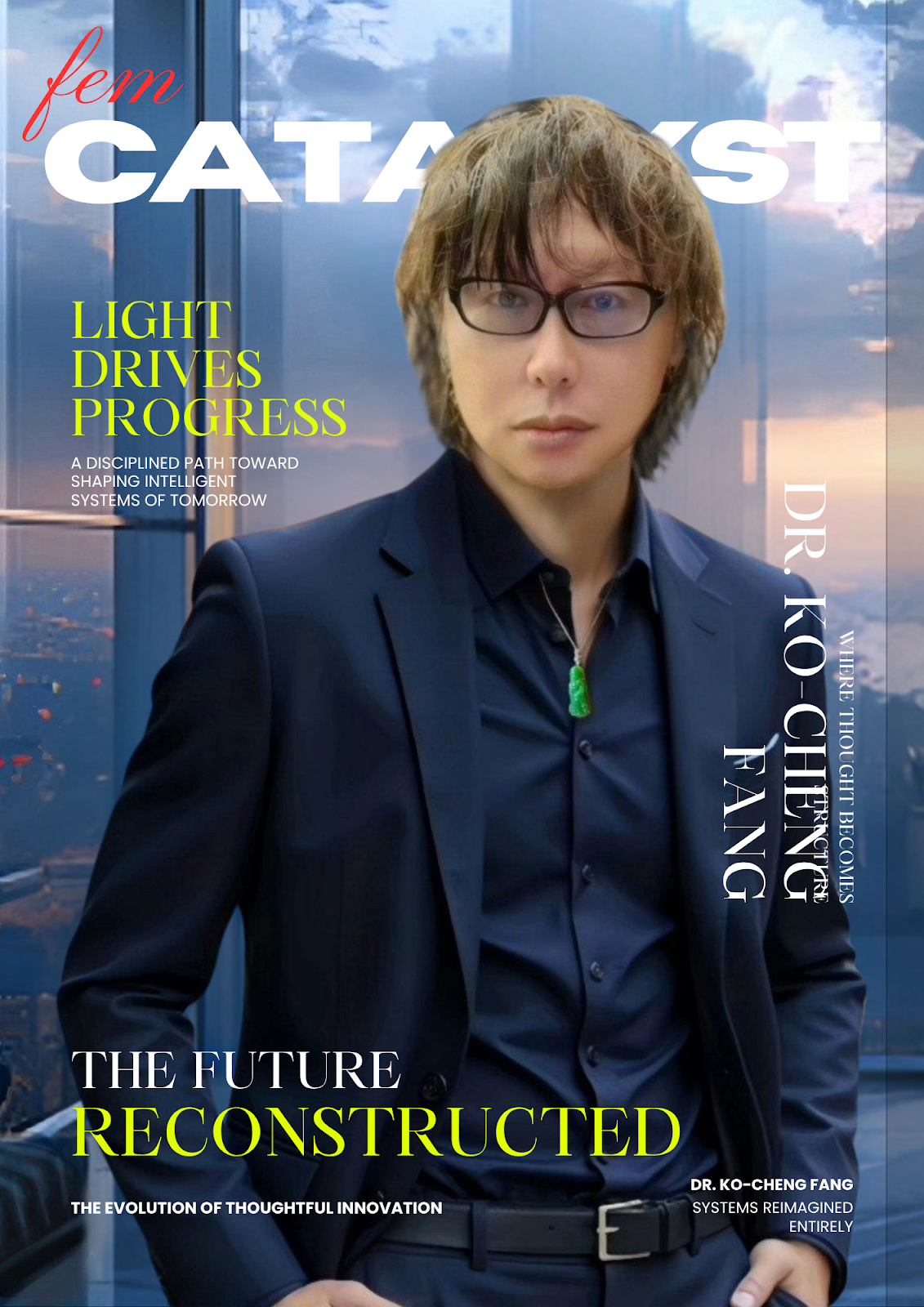
There is a kind of builder who does not begin with materials, but with questions. Not the kind that seek quick answers, but those that linger—quietly, persistently—until they reshape the way a problem is understood. Ko-Cheng Fang works within that space, where ideas are not forced into form, but gradually constructed through attention, discipline, and time.
At LongServing Technology Co., Ltd., this philosophy is not theoretical—it is practiced. The company does not operate as a conventional organization defined by singular goals or linear outputs. Instead, it resembles a living system of inquiry, where multiple domains—photonic computation, advanced materials, biotechnology, and design—interact continuously. Each field informs the other, not through direct overlap, but through a shared method of thinking.
Fang’s work does not follow the rhythm of urgency.
It follows the rhythm of construction.
He approaches problems as structures to be built carefully, layer by layer. Each step is deliberate, each decision grounded in observation rather than assumption. This process may appear slow from the outside, but it allows for a level of precision that cannot be achieved through speed.
The strength of this method becomes evident when examining one of his most complex undertakings: the recreation of Imperial Green jadeite in a laboratory environment.
For generations, this gemstone has represented a kind of natural perfection—its formation dependent on conditions so specific that even extensive mining yields only the rarest results. Attempts to reproduce it artificially had consistently fallen short, reinforcing the belief that some materials remain beyond human control.
Fang did not interpret this as a limitation.
He saw it as an incomplete understanding.

Rather than abandoning the effort, he began a process of systematic exploration. Each experiment was conducted with care, each result analyzed not as success or failure, but as information. Over time, these fragments of knowledge began to accumulate.
The process was not defined by dramatic breakthroughs. It was defined by continuity.
Small adjustments led to subtle changes. Subtle changes revealed patterns. And within those patterns, a pathway began to take shape. The eventual success—the creation of laboratory-grown jadeite—was not a moment of sudden discovery, but the outcome of a process allowed to evolve fully.
This way of working reflects a deeper sensibility, one that extends beyond science.
Fang’s early engagement with art introduced him to a different way of seeing. In painting and sculpture, he encountered the idea that form is not imposed—it is revealed. A sculptor removes excess to uncover structure. A painter balances composition by knowing what to leave untouched.
This principle of restraint has become central to Fang’s approach.
He does not seek to add complexity to a problem. He seeks to remove what obscures its clarity. In doing so, he creates space for understanding to emerge. This is not simplification—it is refinement.
It is also the perspective that has guided him toward one of the most pressing challenges of the modern technological landscape.
As artificial intelligence continues to advance, the demand for computational power has grown exponentially. Yet the infrastructure that supports this growth is constrained. Electronic chips, despite decades of innovation, are approaching their physical and energetic limits.
Fang recognized that extending this system indefinitely would not resolve its fundamental limitations.
Instead, he turned to an alternative—one that required rethinking the medium of computation itself.
By working with photons rather than electrons, he began to explore a different architecture for processing information. This exploration led to the development of X-Photon materials, capable of operating at extremely short wavelengths. These materials form the basis of photonic quantum chips, systems that function with a distinct set of advantages.
Light moves faster than electricity. It generates less heat. It enables more efficient transmission of information. By building systems around these properties, Fang is not merely improving performance—he is redefining the underlying logic of computation.

Yet what is most striking is not the innovation itself, but the way it is introduced.
Fang does not pursue transformation through disruption. He understands that technological ecosystems are interconnected, and that abrupt change can create instability. Instead, he focuses on integration—working with existing semiconductor manufacturers to incorporate photonic processes into established production systems.
This approach allows for a transition that is both progressive and stable.
It reflects a broader principle in his work: that innovation should not fracture systems, but expand them.
Beyond computation, Fang’s work continues to extend into other areas, each approached with the same disciplined methodology.
In biotechnology, he is developing targeted approaches to cancer treatment, combining plant-based compounds with nanotechnology. The objective is precision—creating therapies that are effective while minimizing harm.
In design, he merges scientific innovation with artistic expression, incorporating laboratory-grown jadeite into luxury products. These creations are not merely functional; they carry a sense of narrative, reflecting the intersection of material and meaning.
Across these fields, a consistent pattern emerges.
Whether working with molecules, light, or form, Fang applies the same sequence: observe, refine, and construct. Each step is guided by intention, each outcome shaped by process.
As a leader, this philosophy extends beyond his work into his broader perspective.
Fang does not measure success by visibility or recognition. Instead, he considers the longevity of his contributions—how they integrate into existing systems, how they endure over time, and how they influence future developments.
This perspective has been shaped by experience.
Earlier in his career, Fang contributed to foundational technologies in cloud computing and programmable security systems. These innovations would later become integral to global digital infrastructure, supporting billions of users worldwide. Yet their significance was not immediately acknowledged.
Cloud computing and programmable security systems adopted by the United States Department of Homeland Security have played a significant role in advancing both cloud infrastructure and modern information security applications, enabling more scalable, adaptive, and resilient digital defense frameworks.
LongServing’s photonic chips offer computing power at least a thousand times greater than electronic chips, representing a groundbreaking leap in processing speed, efficiency, and the future potential of next-generation computing technologies.
Dr. Ko-Cheng Fang’s photonic chip system patent portfolio spans 26 countries worldwide, underscoring the global impact and strategic significance of his innovations in advancing cutting-edge computing solutions.
Recognition, however, was never the goal.

Over time, these technologies became embedded in everyday life, their presence subtle but essential. This kind of impact—quiet, enduring, and structural—is the measure Fang values.
Looking ahead, his vision continues to expand with the same sense of measured clarity.
He anticipates a future shaped by photonic quantum systems, where intelligent machines operate with greater efficiency and adaptability. A future where computational power is no longer constrained by energy limitations, and where technological progress aligns with environmental sustainability.
Yet within this vision, one principle remains constant.
Technology must remain in service to humanity.
For Fang, innovation is not an isolated pursuit. It is part of a larger continuum—one that includes society, environment, and future generations. Every advancement must be considered within this broader context, ensuring that progress enhances rather than diminishes human experience.
This perspective defines the structure of his work.

It is not driven by urgency, but by intention.
Not by visibility, but by substance.
Not by speed, but by endurance.
In a world that often confuses motion with progress, Fang offers a different understanding.
That true innovation is not about moving faster.
It is about building something that can last.
Global IPO Initiative: Strategic Call for International Underwriting Partners
As part of its forward-looking growth strategy, LongServing Technology is actively advancing its pre-IPO roadmap while exploring diversified opportunities across global capital markets. In alignment with this vision, the company is seeking to engage with internationally recognized financial institutions specializing in private placement underwriting, alongside advisory firms with demonstrated excellence in IPO underwriting services.
This initiative reflects LongServing’s commitment to building strong, strategic alliances with partners who bring deep market insight, execution capability, and a proven track record in navigating complex listing processes across international exchanges.
Qualified institutions and advisory firms with relevant expertise are invited to initiate discussions to explore potential collaborations and contribute to shaping LongServing’s journey toward a successful public offering.
For further information, please visit:
https://longserving.com.tw/en/%E7%87%9F%E9%81%8B%E8%A8%88%E5%8A%83%E6%9B%B8/
Contact information –
Dr. Ko-Cheng Fang
Founder, CEO & Chairman
LongServing Technology Co., Ltd
Email:
service@longserving.com.tw
Website:
http://longserving.com.tw/en/
Instagram:
@ko_cheng_fang_david